Divination methods
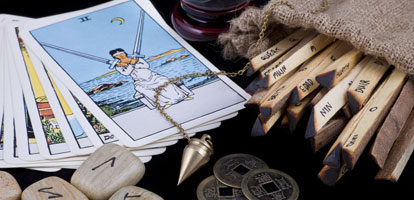 Divination is a practice using different methods to foretell the future. There are those who are gifted and by practicing the different techniques will make predictions of the future..
Without a doubt, the method that is most commonly used and one that is most known is the Tarot, which is an ancient type of reading and to this day, continues as a tool to help improve the way to the future in different aspects like love.
All will depend on what you need to know in specific. In continuation, we will tell you about some of the most commonly used methods of divination. Tarot
The tarot is one of the methods of divination that is most commonly used. It is recognized as an excellent oracle at the time to help people to discover their direction in life and help them to be able to have a prosperous future.
Many will ask how it works, but it''s very simple, someone with their developed intuition and by using the cards will be able to tune in with the others and know what will be in the future. It is to say, there are certain events that occur beyond time and space and they are related with other events. All of this is presented by the tarot and that I show an interpretation will begin.
Without any doubts, the tarot is the ancient type of reading and to this day will continue as a tool to help to improve the road to the future.
Runes
The runes are another ancient tool of divination based on the ancient German alphabet. The word rune signifies "mystery". This means of divination is used in ancient times, about 300 years before Christ everywhere in Scandinavia, Germany and in other parts of Europe.
Rune Reading is one of the most complex methods of divination and it consists in asking 1 question, tossing the runes and there, the clairvoyant with his or her, esoteric knowledge will interpret the significance of the runes.
The runes tend to be an excellent resource to explore issues or challenges and to ask open type of questions.
Coffee ground reading
It is another technique very commonly used and works in a simple way. You choose a given time to do the Reading and according to your intuition and its psyche surcharge that has been left there, the clairvoyant will interpret the symbols that are formed and left in the coffee grounds.
Numerology
Divination through numerology was used by ancient Egyptian and Chinese people, to know the future.
The basis is that all can be reduced to a number, even the universe is built on numbers. Through numerology we can find our unique potential, describing the roads that change according to the way in which we react to life. Through numerology you can find your personal number vibration and that way, discover the moment of the day, the year and the month that is more conducive to take on your maximum potential.
Palm Reading
Palm Reading is also known as Quiromancy and it consists in Reading the palm of the hand of a certain person. It is an Antique method of divination used by various cultures around the world like, Hindus, Egyptians, Chinese and the Greeks.
Through the analysis of the lines and forms of the hand, the clairvoyant can see the significance and will interpret the meanings. Everyone comes into existence with a Karmic condition of their past life, which is transmitted to his or her body and Quiromancy is a way to transmit this information from other past lives to resolve this condition and to find an illumination or at least, find solutions to the problems of the present time.
These are a few of the different forms of divination or the most known and used throughout history.
Do not hesitate to contact us and for any type of issue or worry, we will be at www.truetarot.com waiting and we will be happy to help you.

Send us your comments / suggestions